

iLet Bionic Pancreas vs Tandem Mobi: How Each Pump Changes Meals, Mental Load, and Your Role in Diabetes Management

Disclaimer: This post is a paid partnership with Beta Bionics. The content reflects my personal experience as someone living with type 1 diabetes and is intended for educational purposes only. Always consult your healthcare provider before making any changes to your diabetes management plan.

Over the past year, I switched back and forth between two very different insulin pumps: iLet Bionic Pancreas and Tandem Mobi with Control IQ+.
My Time in Range was nearly identical on both, but the day-to-day experience was almost completely different.
I’m not here to list every feature or tell you which pump to pick. Instead, I want to share what it actually feels like to live with each system: how meals go, how much mental space diabetes takes up, and how your role in diabetes care changes depending on which pump you’re wearing.
Meal Announcements
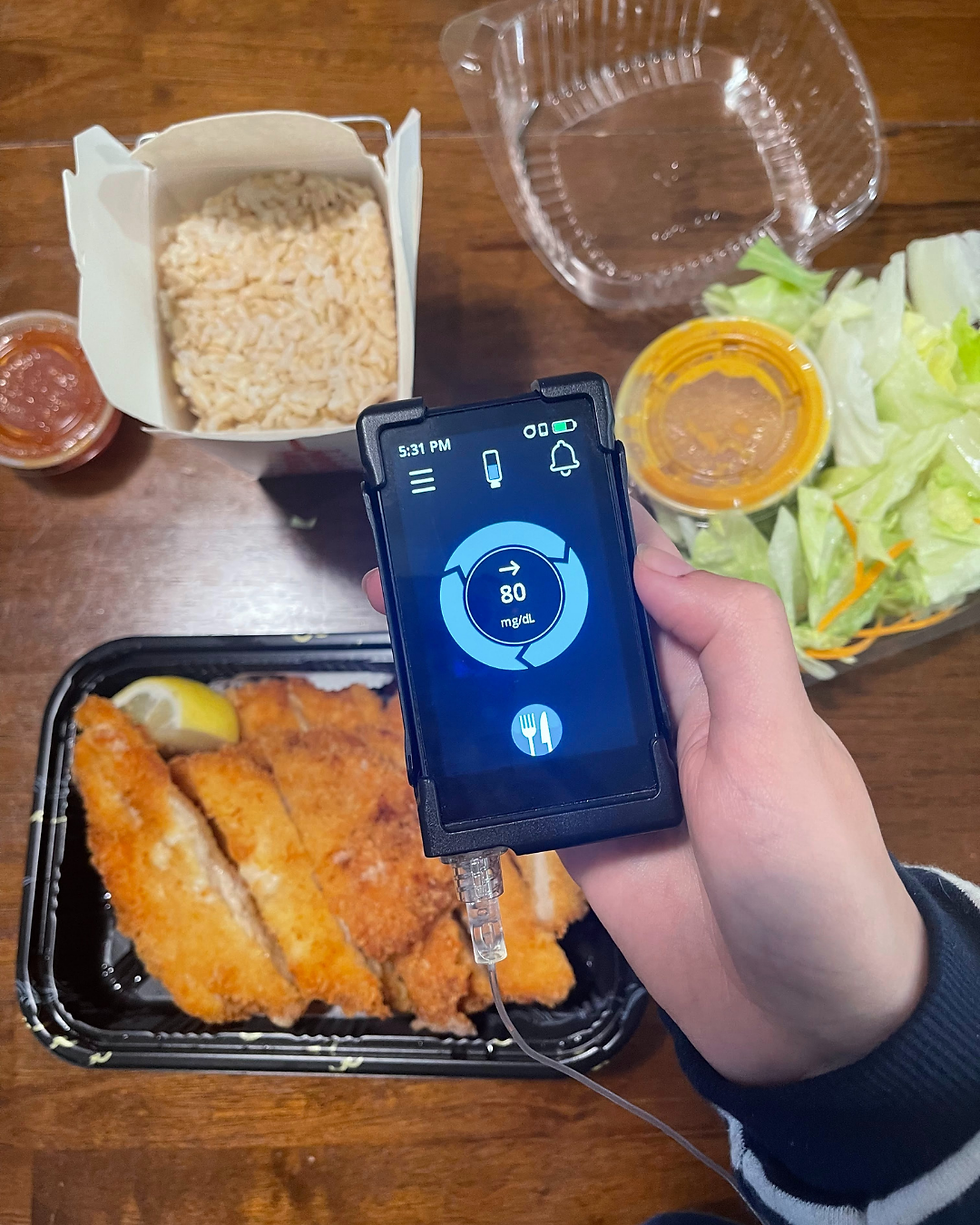
Of all the differences I noticed between these two pumps, mealtimes were the most immediate.
iLet Bionic Pancreas Meal Announcements
With the iLet, carb counting disappeared from my routine. Instead of pulling up the calculator app on my phone or second-guessing portions, I simply announced my meal as usual, more or less– and moved on. There was no pressure to translate my plate into a precise number.
Behind the scenes, the system delivered a conservative upfront bolus (around 75%) and then continuously adapted based on how my blood sugar actually responded. It didn’t rely on my estimate being exact– it watched, learned, and adjusted in real time either delivering more insulin when needed or easing off if the response was stronger than expected.
What stood out to me the most was that imprecision wasn't a problem to overcome– it was something the system was built to handle. The iLet doesn't expect you to nail your carb estimate. Whether the meal was larger than expected or slower to digest, the iLet responded automatically.
Over time, meals stopped feeling like decisions that required planning, math, and follow-up. The iLet didn’t eliminate diabetes, but it removed the constant pressure to get everything right and quietly handled the parts I used to carry on my own.
Tandem Mobi with Control IQ+ Meal Announcements
With the Tandem Mobi, my carb estimate was the foundation for every meal. On days when my carb input was on point, there was something genuinely satisfying about watching my own choices play out in real time.
But accuracy wasn’t always achievable for me. When my estimate was off, even by a little, the system had limited room to recover. Control IQ+'s autobolus is intentionally partial (~60%), which means any gap between what I entered and what I actually ate falls on me to either catch in advance or correct afterward.
This isn’t a flaw in the pump–it’s just how the system is designed. The Mobi is a capable, responsive system that rewards the effort you put into it. But it does require consistent effort, at every meal, every day. When I had the mental bandwidth to bring that focus, it delivered. When life got in the way and I couldn't, the weight of that ongoing responsibility became harder to carry and I found myself missing the iLet that was built to handle the variability on my behalf.
Mental Load & Your Role in Diabetes Management

The difference at mealtimes was obvious from the start, but the difference in mental load revealed itself more slowly. Over time, I realized each system wasn’t just changing how insulin was delivered– it was changing my role in diabetes management and how much mental energy I was expected to carry each day.
iLet Bionic Pancreas
With the iLet, my only real job was announcing meals. Basal rates weren't visible, adjustments weren't an option, and most of the decision-making happened without me. At first, that felt unnatural. Watching a blood sugar climb and doing nothing went against every instinct I'd built over years of managing diabetes.
But over time, something shifted. The fewer decisions I had to make, the less mental space diabetes occupied. I stopped running through "what ifs" after meals, stopped hovering over my CGM, and gradually stopped thinking of myself as someone actively managing my diabetes. I was living alongside it instead. That was a relief I hadn't anticipated.
My role had shifted from constant manager to occasional participant. I gave the system enough information and let it take it from there.
Tandem Mobi
With the Mobi, I could see far more: basal rates, adjustment history, settings I could tweak and optimize. And every visible setting became something to consider. I found myself checking numbers more often, weighing whether to intervene, and making small decisions throughout the day that the iLet would have simply handled on its own.
This created a different kind of mental load– more active, decision-oriented, and constantly engaged. I was aware of the system working in the background, but also aware of the choices I could make on top of it. Some days, this meant feeling in control and responsive, but other days, the number of decisions and options felt like extra mental work.
That's not a flaw. But it does mean your role with the Mobi is fundamentally different– you're not just wearing a pump, you're collaborating with it. And collaboration takes energy. On days when I had that energy, the Mobi rewarded it. On days when I didn't, I felt the weight of every decision I still had to make.
Which One Is Best?
I didn’t choose one pump over the other because one performed better. I chose them based on what I needed from diabetes management at different points in my life.
When I was burnt out and needed to step back, the iLet gave me room to breathe. It lifted the mental weight, simplified my role, and let diabetes run quieter in the background. When I was ready to re-engage– when I wanted to feel the connection between my decisions and my outcomes– the Mobi gave me that. Both systems supported me in different ways.
The lesson I keep coming back to is this: there’s no one-size-fits-all for diabetes and it’s 100% okay to change your mind.
The answer isn’t fixed. It can evolve over time. And recognizing that may be the most valuable takeaway from any pump comparison– including this one.
